How to Use a Mortgage Calculator Before Buying a Home
Why You Need a Mortgage Calculator
Buying a home is probably the largest financial decision you'll ever make. And yet, most people spend more time researching which refrigerator to buy than understanding what their mortgage will actually cost them. That's not a criticism; mortgage math is genuinely confusing. Interest compounds in ways that aren't obvious, loan terms have long-range effects that are hard to picture, and lenders present numbers in ways that don't always make the full picture clear.
A mortgage calculator gives you the power to see the real numbers before you sign anything. You can plug in a home price, a down payment, an interest rate, and a loan term, and within seconds you'll know your estimated monthly payment, how much interest you'll pay over the life of the loan, and how every extra dollar you put toward principal changes the outcome. That's not information you should be learning for the first time at a closing table.
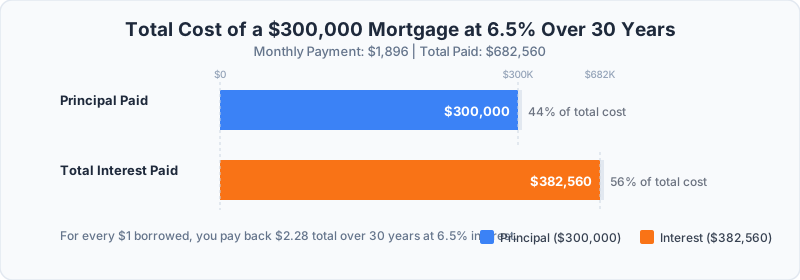
Here's the reality: a 30-year mortgage on a $350,000 home at a 7% interest rate will cost you roughly $488,000 in total payments over those three decades. That means you're paying nearly $138,000 in interest alone, on top of the home price. A mortgage calculator makes that number visible before you commit. Without one, you're essentially agreeing to a contract worth nearly half a million dollars without reading the full terms.
Beyond total cost, a mortgage calculator helps you compare scenarios quickly. What happens if you put 10% down instead of 5%? How much do you save if you choose a 15-year loan instead of a 30-year loan? What's the monthly payment difference between a $320,000 home and a $350,000 home? These comparisons take seconds with a calculator and might take hours with a spreadsheet (or a call to a loan officer who has a vested interest in getting you approved for as much as possible).
You should also use a mortgage calculator before you start house hunting, not after. Knowing your realistic payment range helps you set a budget you can actually stick to, which means you won't fall in love with a house that will stretch your finances to the breaking point.
What Goes Into a Mortgage Payment
Most people think a mortgage payment is just principal and interest. That's true for the loan itself, but your actual monthly housing payment usually includes several more components, all bundled together under the acronym PITI: Principal, Interest, Taxes, and Insurance. Understanding each part helps you budget accurately and avoid surprises after you close.
Principal is the portion of your payment that goes toward paying down the actual balance you borrowed. In the early years of a mortgage, this is a relatively small slice of your payment. As time goes on and your balance shrinks, more of each payment goes toward principal.
Interest is the cost the lender charges you for borrowing the money. In the early years, interest makes up the vast majority of each payment. On a 30-year loan at 7%, your first monthly payment might be roughly 75% interest and only 25% principal. That ratio flips gradually over time.
Property Taxes are collected by your local government and are based on your home's assessed value. Lenders typically collect a portion of your annual property tax bill each month and hold it in an escrow account, then pay the tax bill on your behalf when it's due. Depending on where you live, property taxes can add several hundred dollars per month to your payment.
Homeowners Insurance protects your home and possessions against damage and liability. Like property taxes, this is often collected monthly and paid out of escrow. A basic policy might cost between $100 and $300 per month, depending on your home's value, location, and coverage level.
PMI (Private Mortgage Insurance) is an additional cost that applies when your down payment is less than 20% of the home's purchase price. PMI protects the lender (not you) in case you default. It typically costs between 0.5% and 1.5% of the loan amount per year, divided across your monthly payments. On a $300,000 loan, that could be $125 to $375 per month. PMI goes away once your loan-to-value ratio drops to 80%, either through paying down your balance or appreciation in your home's value.
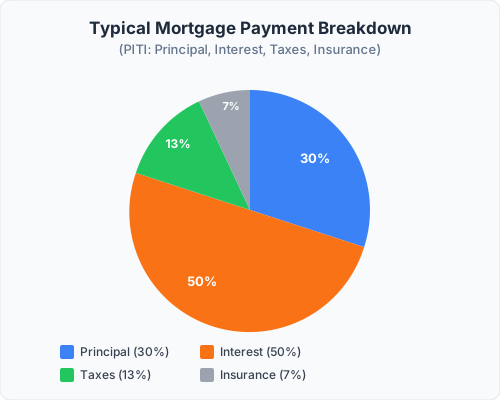
When you use a mortgage calculator, you may have the option to include taxes and insurance in your estimate, or the calculator might show you just principal and interest. Always know which one you're looking at. The "PITI" payment is what you'll actually be paying each month, and it can be 30% to 50% higher than principal and interest alone.
How to Use a Mortgage Calculator
Using a mortgage calculator is straightforward once you know what numbers to enter. Here's a step-by-step walkthrough of each input field you'll typically encounter.
Step 1: Enter the Home Price. This is the purchase price of the home you're considering. If you're still in the browsing phase, you can enter a target price range and run the calculator multiple times to compare. Don't use a price you hope to negotiate down to; use the listed price as a starting point.
Step 2: Enter Your Down Payment. You can enter this as either a dollar amount or a percentage. Common down payment amounts are 3% (minimum for many conventional loans), 3.5% (FHA loans), 10%, and 20%. The larger your down payment, the smaller your loan balance, the lower your monthly payment, and the more likely you are to avoid PMI.
Step 3: Enter the Interest Rate. This is the annual interest rate on your loan, expressed as a percentage. You can use current average rates as a starting point, but the rate you actually qualify for depends on your credit score, debt-to-income ratio, loan type, and the lender you choose. Even a half-percent difference in rate has a surprisingly large impact on total interest paid over 30 years.
Step 4: Choose the Loan Term. Most mortgages are either 15 years or 30 years, though some lenders offer 10, 20, or 25-year terms. A 30-year term gives you a lower monthly payment but means you pay far more in total interest. A 15-year term has a higher monthly payment but dramatically reduces your total cost.
Step 5: Add Taxes and Insurance (optional). Some calculators let you include estimated annual property taxes and homeowners insurance. If you can find these numbers for the home you're looking at, enter them for a more accurate total monthly payment estimate.
Try it now using the CalcLive Mortgage Calculator. You can adjust every variable in real time and see how changes to the interest rate, down payment, or loan term affect your monthly payment and total interest paid.
A few tips while you're using the calculator: run at least three scenarios. Try a 30-year and a 15-year loan to see the difference. Try a 10% down payment versus 20% to see how PMI affects things. And try a price that's 10% lower than your target to see what headroom that creates in your budget.
Understanding Amortization
Amortization is the process by which your loan balance decreases over time as you make payments. Understanding how it works will change how you think about every mortgage payment you make.
Here's the core concept: your monthly payment stays the same for the life of a fixed-rate mortgage. But the split between interest and principal shifts over time. In the early years, the majority of your payment goes toward interest because your loan balance is high. As the balance decreases, less interest accrues each month, which means more of your fixed payment goes toward principal. This process accelerates toward the end of the loan.
Consider a $300,000 mortgage at 7% for 30 years. Your monthly payment (principal and interest only) is about $1,996. In your very first payment, roughly $1,750 goes toward interest and only about $246 goes toward reducing your balance. After one full year of payments, you've paid nearly $24,000 but your balance has only dropped by about $3,000.
By year 15, the split is more even: around $1,200 toward interest and $800 toward principal each month. By year 29, nearly the entire payment goes toward principal.
This is why paying extra toward principal in the early years of a mortgage has such a large impact. Every dollar of extra principal payment eliminates future interest charges that would have been applied to that dollar for years or even decades. Use the CalcLive Amortization Calculator to see a full year-by-year or month-by-month breakdown of exactly how your loan balance decreases over time.
An amortization schedule is also useful for understanding your home equity at any point in time. Equity is the difference between your home's market value and your remaining loan balance. Knowing where you are on the amortization curve helps you understand how much equity you've built and whether you might qualify to remove PMI or refinance at a better rate.
How Much House Can You Afford?
This is the question everyone asks, and there's a standard rule of thumb that gives you a quick starting point: the 28% rule. According to this guideline, your monthly housing payment (PITI) should not exceed 28% of your gross monthly income. Lenders also look at a broader metric called the debt-to-income ratio (DTI), which compares all your monthly debt payments (housing, car loans, student loans, credit cards, etc.) to your gross income. Most lenders want your total DTI to be 43% or lower, and many prefer it under 36%.
Here's a quick reference table showing how the 28% rule translates across different income levels:
| Annual Income | Gross Monthly Income | Max Monthly Housing Payment (28%) | Estimated Max Mortgage (30yr, 7%) |
|---|---|---|---|
| $50,000 | $4,167 | $1,167 | ~$175,000 |
| $75,000 | $6,250 | $1,750 | ~$263,000 |
| $100,000 | $8,333 | $2,333 | ~$350,000 |
| $150,000 | $12,500 | $3,500 | ~$525,000 |
Keep in mind that "max mortgage" in the table above is the loan amount, not the home price. You'll add your down payment to that figure to get the total home price you can afford. Also, the table uses 7% and a 30-year term as estimates; your actual rate and term will vary.
The 28% rule is a guideline, not a law. Your actual comfort level depends on your other financial goals, your job stability, whether you have children, your savings rate, and dozens of other factors. Many financial advisors suggest being more conservative than the rule allows, especially if you're in a high cost-of-living area or have other significant expenses. Use the CalcLive House Affordability Calculator to get a more personalized estimate based on your full financial picture.
One thing to watch out for: lenders will often approve you for more than you should actually spend. Getting pre-approved for $450,000 doesn't mean $450,000 is the right number for your budget. Always run the numbers yourself and decide what payment fits your life, not just what a lender says you qualify for.
Fixed vs. Adjustable Rate Mortgages
When you're shopping for a mortgage, one of the most important decisions is whether to choose a fixed-rate or adjustable-rate mortgage (ARM). Each has genuine advantages and trade-offs, and the right choice depends on your situation, how long you plan to stay in the home, and your tolerance for financial uncertainty.
Here's how three common loan types compare on a $300,000 loan:
| Loan Type | Interest Rate | Monthly Payment (P&I) | Total Interest Paid | Pros | Cons |
|---|---|---|---|---|---|
| 30-Year Fixed | 7.00% | $1,996 | $418,527 | Predictable payment, stability | More total interest, slower equity build |
| 15-Year Fixed | 6.50% | $2,613 | $170,342 | Much less interest, faster payoff | Higher monthly payment, less cash flexibility |
| 5/1 ARM | 6.00% (initial) | $1,799 (initial) | Varies after year 5 | Lower initial payment | Rate uncertainty after fixed period ends |
The 30-year fixed is the most popular mortgage in the United States for good reason. Your payment stays the same for three decades. You can budget around it reliably. The trade-off is that you pay a lot more in interest over time, and you build equity slowly in the early years.
The 15-year fixed cuts your interest bill dramatically. In the example above, you'd pay $248,000 less in interest over the life of the loan compared to the 30-year. The catch is that your monthly payment is about 31% higher, which squeezes your monthly budget more and leaves less cash available for other investments, emergencies, or lifestyle expenses.
The 5/1 ARM has a fixed rate for the first five years, then adjusts annually based on a benchmark index (like the Secured Overnight Financing Rate, or SOFR) plus a lender margin. The initial rate is usually lower than a 30-year fixed, which can be appealing. But after year five, your payment could go up significantly if interest rates have risen. ARMs make more sense if you plan to sell or refinance before the initial fixed period ends.
There's no universally right answer here. If you plan to stay in the home for 30 years and want certainty, the 30-year fixed is hard to beat for peace of mind. If you can comfortably afford the higher payment and want to build equity fast, the 15-year fixed saves you an enormous amount of money. If you're confident you'll move within five to seven years, the ARM might make sense.
Should You Rent or Buy?
The rent vs. buy decision is more nuanced than it might appear. Buying isn't always the smarter financial move, and renting isn't always "throwing money away." Both options have real costs and real benefits, and the right answer depends on your circumstances.
Here are the key factors to think through:
How long do you plan to stay? Buying a home comes with significant upfront costs: closing costs (typically 2% to 5% of the home price), moving costs, immediate repairs or upgrades, and the transaction costs if you sell relatively soon. The general rule of thumb is that you need to stay in a home for at least three to five years for buying to make financial sense over renting. If you move every two years for work, renting is likely better.
What's the price-to-rent ratio? In some cities, home prices are so high relative to rents that buying is far more expensive on a monthly basis, even before accounting for maintenance, taxes, and insurance. In other markets, buying costs about the same as renting or less. The price-to-rent ratio (annual home price divided by annual rent) above 20 generally suggests renting might be more efficient; below 15 suggests buying is favorable.
What's your opportunity cost? The money you put into a down payment could instead be invested in the stock market. Over long periods, the stock market has historically returned around 7% annually after inflation. If your home appreciates at 3% and the stock market returns 7%, there's an argument for renting and investing the difference, though this ignores the emotional and practical benefits of homeownership.
Are you financially ready? Beyond the down payment, buying a home means being responsible for all maintenance and repairs, property taxes, insurance, and potentially HOA fees. Experts recommend having a maintenance reserve of about 1% of the home's value per year. For a $350,000 home, that's $3,500 per year, or about $292 per month you should set aside.
Use the CalcLive Rent vs. Buy Calculator to run a personalized comparison based on your local market, your expected time in the home, and your investment return assumptions.
Down Payment Strategies
How much should you put down? The traditional wisdom says 20%, and there are good reasons for that number. A 20% down payment eliminates PMI, gives you instant equity, and results in a lower loan balance and lower monthly payment. On a $300,000 home, 20% down is $60,000, which is a significant amount to save.
But 20% isn't mandatory, and waiting until you've saved that much might not be the right move in every market. Here are the most common down payment options and their trade-offs:
3% to 3.5% down is available through conventional loans (with some first-time buyer programs) and FHA loans. This gets you into a home sooner but means you'll pay PMI and have a higher loan balance. FHA loans also come with mortgage insurance premiums (MIP) that work differently from conventional PMI and can be harder to remove.
5% to 10% down is a middle ground that's increasingly common. You'll still pay PMI until your loan-to-value ratio reaches 80%, but your monthly payment is lower than with a 3% down payment, and you're not waiting years to save 20%.
20% down is the traditional benchmark. No PMI, lower monthly payment, better loan terms from most lenders, and a stronger offer in competitive markets.
More than 20% down can make sense if you have substantial savings and want to minimize monthly obligations, but you should weigh this against keeping money liquid for emergencies and other investments.
There's also a practical consideration in competitive markets: a larger down payment can make your offer more attractive to sellers because it signals financial stability and reduces the risk that financing will fall through.
Use the CalcLive Down Payment Calculator to figure out how much you need to save based on your target home price, your preferred down payment percentage, and your savings timeline.
Paying Off Your Mortgage Early
If you want to save a significant amount of money on interest and own your home outright sooner, there are several strategies for paying off your mortgage ahead of schedule. The math here is genuinely powerful.
Biweekly payments. Instead of making one monthly payment, you make half a payment every two weeks. Because there are 52 weeks in a year, this results in 26 half-payments, which equals 13 full payments instead of 12. That one extra payment per year can shave four to six years off a 30-year mortgage and save tens of thousands of dollars in interest, without significantly changing your budget.
Extra principal payments. Even adding a small amount to your principal each month makes a meaningful difference over time. On a $300,000 mortgage at 7%, adding just $200 per month toward principal saves approximately $63,000 in interest and cuts about five years off a 30-year loan.
Lump-sum payments. Applying a bonus, tax refund, or windfall directly to your mortgage principal is one of the most efficient uses of that money if your mortgage rate is high relative to other investment options. In a high-rate environment (say, 7%+), paying down mortgage principal is essentially a guaranteed 7% return, which is competitive with many investments.
Refinancing to a shorter term. If your income has grown since you took out your mortgage, refinancing from a 30-year to a 15-year loan can accelerate payoff while potentially securing a lower rate as well.
Before you commit to early payoff, think about whether you have high-interest debt (credit cards, personal loans) that should be paid first. Paying off 22% credit card debt is mathematically better than paying off a 7% mortgage. Also make sure you have an emergency fund in place before putting extra money toward your mortgage.
Use the CalcLive Mortgage Payoff Calculator to see exactly how much interest you'd save with different extra payment strategies and how many years you'd knock off your loan term.
Frequently Asked Questions
How accurate is a mortgage calculator?
A mortgage calculator is highly accurate for estimating principal and interest payments, as long as you enter the correct loan amount, interest rate, and term. The estimate becomes less precise when property taxes, insurance, and PMI are added, since those vary by location, home value, and your specific situation. Use the calculator as a planning tool to compare scenarios and set a budget range, then work with a lender to get exact figures based on your actual qualifications.
What credit score do I need to buy a house?
The minimum credit score varies by loan type. FHA loans allow scores as low as 500 with a 10% down payment, or 580 with 3.5% down. Conventional loans typically require a minimum of 620, but you'll get significantly better interest rates with a score of 740 or higher. VA loans (for eligible veterans and service members) and USDA loans have more flexible credit requirements. Your credit score affects not just whether you qualify, but the interest rate you're offered, which has a large impact on your total cost over the life of the loan.
What's the difference between pre-qualification and pre-approval?
Pre-qualification is an informal estimate from a lender based on self-reported information about your income, assets, and debts. It gives you a rough idea of what you might qualify for, but it's not verified and carries little weight with sellers. Pre-approval is a more formal process where the lender verifies your financial information, pulls your credit report, and issues a conditional commitment to lend up to a specific amount. In competitive markets, sellers often require a pre-approval letter with any offer.
How does PMI work and when can I remove it?
Private mortgage insurance (PMI) is required on conventional loans when your down payment is less than 20%. The cost typically ranges from 0.5% to 1.5% of the loan amount per year, added to your monthly payment. By law (under the Homeowners Protection Act), lenders must automatically cancel PMI when your loan balance reaches 78% of the original purchase price, as long as you're current on payments. You can also request cancellation once your balance reaches 80% of the original purchase price, either through principal payments or a new appraisal showing increased home value. For FHA loans, mortgage insurance works differently and is harder to remove.
Can I afford a $400,000 home?
Whether you can afford a $400,000 home depends on your down payment, interest rate, and income. Using 20% down ($80,000), a $320,000 loan at 7% for 30 years produces a principal and interest payment of about $2,129 per month. Add property taxes, insurance, and other costs, and your total PITI could be $2,600 to $3,000 per month or higher depending on location. Using the 28% rule, you'd need a gross monthly income of about $9,300 to $10,700, or roughly $112,000 to $128,000 per year. With a smaller down payment, the loan balance (and monthly payment) would be higher, and you'd also pay PMI.
What's a good mortgage interest rate?
What counts as a "good" rate depends entirely on the broader interest rate environment at the time you're borrowing. Rates fluctuate based on Federal Reserve policy, inflation, and market conditions. Historically, rates below 5% have been considered quite favorable, and anything below 4% has been exceptional. In periods when rates are higher (6% to 8%), the best strategy is to get the lowest rate you personally qualify for, and to know that you can potentially refinance if rates drop significantly in the future. Shopping at least three to four lenders and comparing their annual percentage rates (APR) is the best way to make sure you're getting a competitive deal.
What happens if I miss a mortgage payment?
Missing one payment doesn't immediately result in foreclosure, but the consequences escalate the longer you wait. After 15 days, most lenders charge a late fee (typically 3% to 5% of the payment amount). After 30 days, the missed payment is usually reported to the credit bureaus, which can significantly damage your credit score. After 90 days, you're typically considered in default, and the lender may begin the foreclosure process. If you're struggling to make a payment, contact your lender before you miss it. Most lenders have hardship programs, forbearance options, or loan modification programs that can help you avoid default.
Ready to Run the Numbers?
Use our free calculators to put these ideas into practice. No signup, no downloads.