How to Use a BMI Calculator: A Complete Guide to Body Mass Index
What Is BMI?
Body Mass Index, almost always shortened to BMI, is a number calculated from your height and weight. The result places you into one of four broad categories: underweight, normal weight, overweight, or obese. Doctors, public health agencies, and insurers have used BMI as a screening tool for more than a century, and it remains the most widely cited weight-related metric in medicine today.
The concept was developed in the 1830s by Belgian mathematician Adolphe Quetelet, who was trying to describe the "average man" in statistical terms. Quetelet never intended his index to be a medical diagnostic tool. Decades later, physiologist Ancel Keys studied large populations and found that the Quetelet Index predicted body fatness reasonably well at the group level. He renamed it the Body Mass Index in 1972, and the term stuck.
Today, the World Health Organization (WHO) uses BMI thresholds to track obesity trends globally. Most primary care physicians check it during annual physicals. It shows up on lab reports, insurance applications, and government health surveys. Understanding what your number means, and what it does not mean, helps you interpret it correctly rather than treating it as an absolute verdict on your health.
BMI is a screening tool, not a diagnosis. A high BMI does not mean you are unhealthy, and a normal BMI does not guarantee good health. It is one data point among many, and this guide will show you how to put it in proper context.
The BMI Formula Explained
The formula itself is straightforward. You divide your weight by your height squared. There are two versions depending on which measurement system you use.
Metric Formula
In the metric system, weight is in kilograms and height is in meters:
BMI = weight (kg) / height (m)2
For example, if you weigh 70 kilograms and stand 1.75 meters tall:
BMI = 70 / (1.75 × 1.75) = 70 / 3.0625 = 22.9
That result sits comfortably within the normal weight range.
Imperial Formula
In the United States, weight is measured in pounds and height in inches. Because the original formula uses metric units, a conversion factor of 703 corrects the calculation:
BMI = (weight (lbs) / height (in)2) × 703
If you weigh 154 pounds and are 5 feet 9 inches tall (69 inches):
BMI = (154 / (69 × 69)) × 703 = (154 / 4761) × 703 = 0.03234 × 703 = 22.7
Both examples land at essentially the same BMI, as they should since 70 kg is about 154 lbs and 1.75 m is about 69 inches.
You can work through this math by hand, but most people find it easier to just plug the numbers into a calculator. One thing to be careful about: if you enter your height in feet and inches, make sure you convert entirely to inches first. A person who is 5 feet 9 inches tall is 69 inches tall, not 59 inches. That error alone can throw your result off dramatically.
How to Use a BMI Calculator
Using an online BMI calculator takes about thirty seconds. Here is how to do it correctly:
- Choose your unit system. Decide whether you want to enter metric (kg, cm) or imperial (lbs, feet/inches) measurements. Most calculators let you toggle between the two.
- Enter your height accurately. Stand against a wall and measure without shoes. Even an inch off can shift your result by a noticeable margin.
- Enter your weight accurately. Weigh yourself in the morning, after using the restroom, and before eating or drinking. Use the same scale each time for consistency.
- Click calculate. The tool displays your BMI number and the category it falls into.
- Note the category. The number matters less than understanding where it places you and what that means for your health context.
You can try this right now using the free BMI calculator on CalcLive. It works for both adults and children, handles metric and imperial units, and gives you an instant result alongside the category ranges so you can see exactly where you land.
One practical tip: do not obsess over tiny fluctuations. Your weight shifts by 2 to 5 pounds throughout any given day depending on hydration, meals, and clothing. Checking your BMI once every few months is more useful than tracking it daily.
BMI Categories and Health Ranges
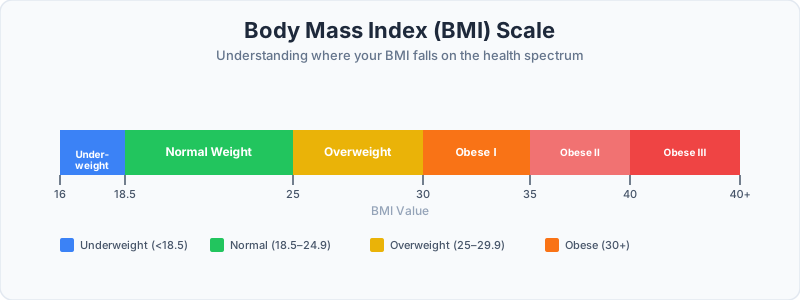
The WHO defines four primary adult BMI categories. The table below shows the ranges, their names, and the general health risks associated with each. Keep in mind these are population-level associations, not individual predictions.
| BMI Range | Category | Associated Health Risk |
|---|---|---|
| Below 18.5 | Underweight | Malnutrition, bone loss, immune suppression, anemia, fertility problems |
| 18.5 to 24.9 | Normal weight | Lowest risk for weight-related diseases in the general population |
| 25.0 to 29.9 | Overweight | Moderately increased risk of type 2 diabetes, hypertension, and joint problems |
| 30.0 to 34.9 | Obese Class I | High risk of cardiovascular disease, type 2 diabetes, sleep apnea |
| 35.0 to 39.9 | Obese Class II | Very high risk, surgical interventions often considered |
| 40.0 and above | Obese Class III (Severe) | Extremely high risk, significant reduction in life expectancy without intervention |

These cutoffs were set primarily from research on European populations. As you will see in the next section, the right threshold varies by ethnicity, age, and other factors. The categories are a useful starting point, not a final answer.
BMI for Different Groups
BMI was designed using data from adult European men. That heritage matters, because it means the standard thresholds may not apply equally to everyone.
Athletes and Highly Muscular People
Muscle tissue is denser than fat tissue. A competitive bodybuilder or professional rugby player may carry very little body fat while having a BMI in the "overweight" or even "obese" range. In these cases, BMI dramatically overstates health risk. If you exercise regularly and have significant muscle mass, your BMI number alone tells you very little about your metabolic health.
Older Adults
As you age, you naturally lose muscle mass and gain fat, sometimes without any change in weight. This means an older adult can have a "normal" BMI while carrying a higher percentage of body fat than ideal. Some research suggests that a BMI in the 25 to 27 range may actually be protective in adults over 65, since it provides a reserve during illness. Talk to your doctor before targeting a specific BMI if you are over 60.
Ethnic and Racial Differences
Substantial research shows that people of Asian descent tend to develop weight-related health problems at lower BMI levels than the WHO thresholds suggest. The WHO itself acknowledges these differences and recommends that many Asian populations use a lower overweight threshold of 23 rather than 25, and an obesity threshold of 27.5 rather than 30. South Asian populations may face elevated cardiometabolic risk at even lower BMI values.
Conversely, some research suggests that people of Black African descent may have higher bone density and muscle mass, meaning standard BMI thresholds could overestimate health risk for this group in some contexts.
Children and Teenagers
You cannot apply adult BMI categories to children. Their bodies are still developing, so what counts as healthy weight changes with age. Pediatric BMI uses age- and sex-specific percentile charts published by the Centers for Disease Control and Prevention (CDC). A child is generally considered underweight below the 5th percentile, healthy between the 5th and 85th, overweight between the 85th and 95th, and obese at or above the 95th percentile. Always use a pediatric BMI chart or consult a pediatrician rather than applying adult cutoffs to a child.
Why BMI Has Limits
BMI is a blunt instrument. It captures two things: your weight and your height. It captures nothing else. Here is what it misses entirely.
Muscle vs. Fat Distribution
Two people can share the exact same BMI while having completely different body compositions. One may have 15% body fat and substantial muscle. The other may have 35% body fat and very little muscle. BMI treats them as identical. Their actual health risk is not identical at all.
Where Fat Is Stored
Visceral fat, the fat stored around your abdominal organs, is far more dangerous than subcutaneous fat stored under the skin in the hips and thighs. Two people with the same BMI can have very different amounts of visceral fat. Waist circumference and waist-to-hip ratio are much better predictors of cardiometabolic risk than BMI alone. A healthy waist circumference is generally below 35 inches for women and below 40 inches for men, though these cutoffs also vary by ethnicity.
Bone Density
Denser bones weigh more. People with higher bone density may register a slightly higher BMI even when their fat mass is perfectly healthy. This is another reason not to treat the number as the whole story.
Sex Differences
Women naturally carry more body fat than men at the same BMI, partly due to reproductive function. A woman with a BMI of 22 and a man with a BMI of 22 have different body fat percentages. This biological difference is built into normal health ranges, but it is worth knowing when you interpret your result.
Health Metrics to Use Alongside BMI
Because BMI has real blind spots, health professionals recommend pairing it with other measurements. Here are the key ones worth tracking.
Body Fat Percentage
Body fat percentage directly measures what BMI only approximates. Methods range from DEXA scans (highly accurate, done in a clinic) to bioelectrical impedance (the scales with hand grips or foot sensors) to skinfold calipers. A healthy body fat range is roughly 10 to 20 percent for men and 18 to 28 percent for women, though optimal ranges shift slightly with age. Use the body fat calculator to estimate yours from simple measurements.
Ideal Weight
Your ideal weight is a target range based on your height, frame size, age, and sex. It gives you a concrete number to aim for rather than just a BMI category. The ideal weight calculator can show you what weight range corresponds to a healthy BMI for your height, plus estimates from several established medical formulas.
Basal Metabolic Rate
Your Basal Metabolic Rate (BMR) is the number of calories your body burns at rest to keep basic functions running. Understanding your BMR helps you set realistic calorie targets for weight management. Check the BMR calculator for a personalized estimate based on the Mifflin-St Jeor equation, which is currently the most accurate formula for most adults.
Daily Calorie Needs
Once you know your BMR, multiplying it by an activity factor gives you your Total Daily Energy Expenditure (TDEE), the actual number of calories you burn per day. Eating consistently above that number leads to weight gain; below it leads to weight loss. The calorie calculator combines your BMR with your activity level to give you a daily calorie target for maintenance, weight loss, or muscle gain.
Waist Circumference
Measure your waist at the level of your navel, relaxed and not sucked in. This single measurement adds important information about visceral fat that BMI cannot capture. If your waist measurement is above the healthy threshold for your sex and ethnicity, that is a reason to act even if your BMI looks fine.
What to Do After Getting Your BMI
Getting your BMI is just the beginning. What you do with it matters more than the number itself. Here is a practical guide for each category.
If You Are Underweight (Below 18.5)
Being underweight raises real health concerns, including a weakened immune system, nutritional deficiencies, hormonal disruption, and decreased bone density. The goal is not just to gain weight but to gain it in a healthy way, building muscle and restoring nutrient stores. See a doctor to rule out underlying causes like thyroid disorders, celiac disease, or disordered eating. A registered dietitian can help you build a realistic plan to increase calorie intake from nutritious foods.
If You Are in the Normal Range (18.5 to 24.9)
You are in a good place. The priority now is maintaining your weight while continuing to focus on fitness, sleep, stress management, and diet quality. Regular exercise that includes both cardiovascular activity and strength training protects against the muscle loss that comes with aging. Recheck your BMI once or twice a year and pay attention to waist circumference trends over time.
If You Are Overweight (25.0 to 29.9)
Being in the overweight category does not automatically mean you are unhealthy, but it is worth taking seriously as a risk factor. Even modest weight loss of 5 to 10 percent of your body weight produces measurable improvements in blood pressure, blood sugar, and cholesterol. Focus on consistent, sustainable changes: reducing ultra-processed food, increasing vegetables and protein, and adding regular physical activity. Avoid extreme diets that produce rapid weight loss followed by rapid regain.
If You Are in an Obese Category (30 or Above)
A BMI in the obese range is associated with significantly elevated risk for serious conditions including type 2 diabetes, cardiovascular disease, certain cancers, and joint problems. The good news is that meaningful health improvements happen well before you reach a "normal" BMI. Reducing your BMI by even 2 to 3 points can lower blood pressure, improve blood sugar control, and reduce inflammation. Work with a healthcare provider to build a realistic plan, which might include dietary changes, exercise, behavioral support, and in some cases medical or surgical interventions. Do not try to tackle severe obesity alone.
Frequently Asked Questions
Is a BMI of 25 bad?
A BMI of 25 sits right at the border between normal weight and overweight. By itself, it is not alarming. Many people at a BMI of 25 are in excellent metabolic health. What matters alongside that number is your body fat percentage, waist circumference, blood pressure, blood sugar, and cholesterol. If those markers are all healthy, a BMI of 25 is not something to worry about. If you have elevated blood pressure or blood sugar on top of it, then modest weight reduction would likely help.
What is a healthy BMI for women?
The healthy BMI range for adult women is the same as for men: 18.5 to 24.9. However, women naturally carry more body fat than men at any given BMI, so body fat percentage norms differ. A woman at a BMI of 22 is not unhealthy just because her body fat percentage is higher than a man at the same BMI. The healthy body fat range for women is roughly 20 to 30 percent depending on age, compared to 10 to 20 percent for men.
Can I use BMI to set a weight loss goal?
Yes, with some caveats. Targeting a BMI within the normal range (18.5 to 24.9) is a reasonable starting point for most adults. However, shooting for the absolute lowest BMI in the normal range is not necessarily better. Many people feel and perform best in the middle of the range. Use the ideal weight calculator to translate your target BMI into an actual weight number, then build your plan from there. Make sure the target is realistic for your frame size and body type.
Can I calculate BMI for my child?
You can calculate a BMI number for a child, but you cannot interpret it using adult categories. For children and teenagers aged 2 to 19, BMI must be plotted on age- and sex-specific growth charts, and the result is expressed as a percentile rather than a category. Below the 5th percentile is underweight. The 5th to 85th percentile is healthy weight. The 85th to 95th is overweight. Above the 95th percentile is obese. Always consult your child's pediatrician for proper interpretation.
How often should I check my BMI?
For most adults, checking BMI two to four times per year is plenty. More frequent checks are not particularly useful because BMI does not change quickly, and day-to-day weight fluctuations from hydration and meals create noise in the data. If you are actively working on weight loss or gain, checking monthly is reasonable as a broad progress indicator. Pair it with waist measurements and how your clothes fit for a more complete picture.
Is BMI the same as body fat percentage?
No. BMI and body fat percentage measure related but distinct things. BMI is a mathematical ratio of weight to height squared. Body fat percentage is the actual proportion of your total body mass that is fat tissue. BMI is easy to calculate from any scale and measuring tape. Body fat percentage requires more specialized measurement. The two numbers correlate loosely at the population level but can diverge significantly for individuals, especially athletes and older adults. Use the body fat calculator to get an estimate of your actual body fat percentage.
What is a dangerously low BMI?
A BMI below 17.5 is considered a clinical warning sign in adults and is one of the diagnostic criteria for anorexia nervosa. At this level, the body begins breaking down muscle and organ tissue for energy, and serious medical complications become likely. A BMI below 15 is considered a medical emergency in most healthcare settings. If you or someone you know is in this range, please seek medical attention promptly. The National Eating Disorders Association helpline is available at 1-800-931-2237.
Do Asian populations use different BMI cutoffs?
Yes. Research consistently shows that people of Asian descent develop conditions like type 2 diabetes and cardiovascular disease at lower BMI values than people of European descent. The WHO expert consultation recommended using a BMI of 23 as the overweight threshold and 27.5 as the obesity threshold for many Asian populations, compared to 25 and 30 for most Western populations. Several Asian countries, including Japan, China, and Singapore, have adopted their own national guidelines using lower cutoffs. If you are of Asian descent, check with your doctor about which thresholds apply to your health assessment.
Ready to Run the Numbers?
Use our free calculators to put these ideas into practice. No signup, no downloads.