How to Plan for Retirement Using a Free Retirement Calculator
Why Retirement Planning Starts Earlier Than You Think
Most people know they should be saving for retirement. What most people don't know is how early "early" actually needs to be. If you're in your 20s and you think retirement planning is a problem for your 40-year-old self to worry about, you're giving away one of the most powerful forces in personal finance: time.
Compounding is the process where your investment returns generate their own returns. A dollar you save today doesn't just sit there. It earns interest, and then that interest earns interest, and that grows year after year. The longer you give it to run, the more dramatic the results become.
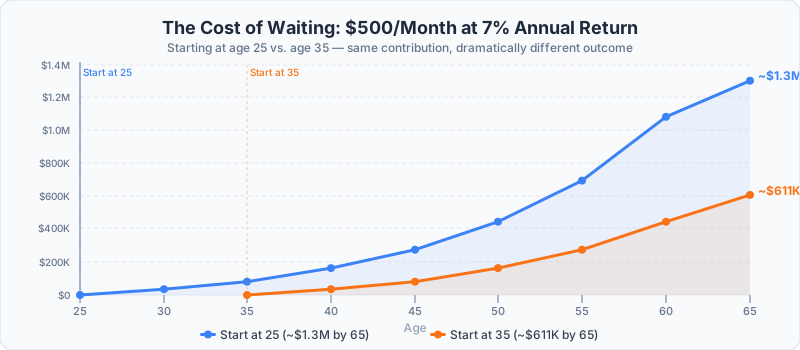
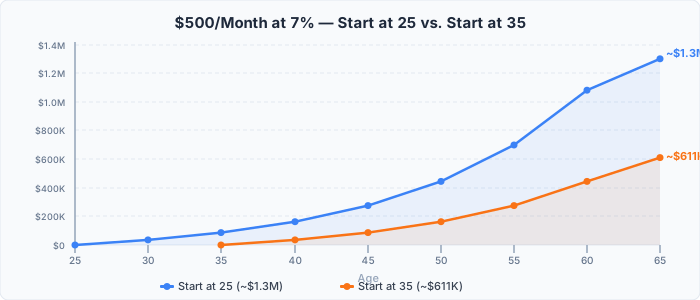
Here's a simple example. Suppose you invest $500 per month starting at age 25, with an average annual return of 7%. By age 65, you'd have around $1.3 million. Now suppose your friend waits until age 35 to start saving the exact same $500 per month at the exact same 7% return. By age 65, they'd have around $610,000. That's roughly half the money, despite only a ten-year difference in start date. Your friend didn't contribute half as much money. They contributed about 25% less. The missing growth is entirely due to lost compounding time.
People also tend to underestimate how much money they'll actually need. A common mistake is thinking "I'll just live on Social Security and a little savings." In 2026, the average Social Security benefit is around $1,900 per month. For most people, that won't come close to covering rent, groceries, utilities, healthcare, and anything resembling a comfortable life. If you want $4,000 or $5,000 per month in retirement income, you need a plan that goes well beyond hoping Social Security picks up the tab.
There's also the life expectancy problem. People are living longer. A 65-year-old today has a realistic chance of living another 25 to 30 years. That means your retirement nest egg needs to last three decades, not just ten or fifteen years. Running out of money at 85 is not a theoretical risk. It's a very real possibility if you don't plan for it.
None of this is meant to scare you. It's meant to give you a realistic picture so you can take action. The earlier you start, the less you actually need to save each month to hit your goal. That's the good news, and it's a strong reason to start today rather than waiting.
The Key Numbers You Need to Plan Retirement
Before you can use a retirement calculator, you need to gather a few core inputs. These numbers will shape every projection you run, so it's worth taking some time to think through each one carefully.
Your Desired Retirement Age
When do you want to stop working? Age 65 is the traditional target, but plenty of people aim for 60, 55, or even earlier. The earlier you retire, the longer your nest egg needs to last and the more you need to save. Be realistic about what's achievable given your current savings rate.
Life Expectancy
No one knows exactly how long they'll live, but for planning purposes, it's smart to assume you'll live to at least 90. If your family has a history of longevity, planning to 95 is reasonable. Planning too short is one of the bigger risks in retirement finance because it leads to drawing down money too quickly.
Current Savings and Investments
What do you have right now? Add up your 401(k) balance, any IRA accounts, taxable brokerage accounts, and any other savings you plan to use in retirement. This is your starting point, and a higher starting balance gives compounding more to work with.
Monthly Contributions
How much are you putting away each month? This includes your own contributions plus any employer match you receive. Even small increases in your monthly contribution can make a big difference over decades. If you're contributing $400 per month and increase it to $500, that extra $100 per month compounds into tens of thousands of dollars over 30 years.
Expected Annual Return
This is the average return you expect your investments to earn each year. A common assumption for a diversified stock and bond portfolio is 6% to 7%. If you're invested primarily in stocks, some planners use 8%. If you have a more conservative mix, 5% might be more appropriate. Don't use extremely optimistic numbers just to make the math work in your favor.
Inflation
The dollar you save today won't buy the same amount in 30 years. Inflation erodes purchasing power over time, and this has a direct effect on how much you need to retire comfortably. Most financial plans use 2.5% to 3% annual inflation as a baseline assumption.
Expected Social Security Benefit
You can get an estimate of your future Social Security benefit by logging into the Social Security Administration's website or using a Social Security calculator. This number matters because it reduces how much income you need to draw from your personal savings in retirement.
How to Use a Retirement Calculator
A retirement calculator takes all those numbers you gathered and projects them forward to show you whether you're on track. Here's how to get the most useful results from one.
Step 1: Enter your current age and target retirement age. This sets the time horizon for your projections. A 30-year-old targeting retirement at 65 has 35 years of compounding ahead. That's a very different situation from a 50-year-old with 15 years to go.
Step 2: Enter your current savings balance. If you have $50,000 in a 401(k) right now, enter that. If you have accounts at multiple institutions, add them together. Use your total retirement savings, not just one account.
Step 3: Enter your monthly contribution. Include everything going into retirement accounts each month, including your employer's match if you receive one. If your employer matches 50% of your contributions up to 6% of your salary, that match counts as part of your monthly savings.
Step 4: Set your expected rate of return. For a rough starting estimate, 6% to 7% is reasonable for a diversified portfolio. You can always run scenarios with lower returns to see how your plan holds up under less favorable conditions.
Step 5: Set your desired monthly income in retirement. Think about what kind of lifestyle you want and what it costs. Don't forget to account for healthcare, travel, and any hobbies you plan to pursue more actively once you stop working.
Step 6: Review the projection and adjust. The calculator will show you whether your current savings rate will get you to your goal. If you're coming up short, it will show you how much the gap is. From there you can experiment with increasing contributions, adjusting your retirement age, or changing your expected return to see what moves the needle.
You can use CalcLive's free retirement calculator to run these numbers right now. It's free and requires no account or signup.
How Much Money Do You Actually Need?
There are two popular rules of thumb that help answer this question: the 4% rule and the 25x rule. They're actually two sides of the same coin.
The 4% Rule
The 4% rule says that if you withdraw 4% of your portfolio in your first year of retirement and then adjust that amount for inflation each year, your portfolio has a high probability of lasting 30 years. This rule comes from a famous study by financial planner William Bengen in 1994, later updated by the Trinity Study, which tested withdrawal rates against historical market data going back to 1926.
For example: if you have $1,000,000 saved, you can safely withdraw $40,000 per year, or about $3,333 per month, with a high probability of not running out of money over a 30-year retirement. This is not a guarantee, because market conditions vary and your actual spending may not follow a predictable pattern. But it's a reasonable planning assumption for most people.
The 25x Rule
The 25x rule is just the 4% rule in reverse. To figure out how much you need to save, multiply your desired annual retirement income by 25. If you want $60,000 per year in retirement, you need $1.5 million saved. If you want $80,000 per year, you need $2 million. This gives you a target to work toward.
Keep in mind that Social Security income reduces how much you need to draw from your portfolio. If you'll receive $2,000 per month from Social Security and you want $5,000 per month total, you only need your portfolio to cover $3,000 per month, which is $36,000 per year. Using the 25x rule, that means you need $900,000 saved rather than $1.5 million.
Required Nest Egg by Desired Monthly Income and Withdrawal Rate
| Desired Monthly Income | Annual Income Needed | At 3% Withdrawal Rate | At 4% Withdrawal Rate | At 5% Withdrawal Rate |
|---|---|---|---|---|
| $2,000/month | $24,000 | $800,000 | $600,000 | $480,000 |
| $3,000/month | $36,000 | $1,200,000 | $900,000 | $720,000 |
| $4,000/month | $48,000 | $1,600,000 | $1,200,000 | $960,000 |
| $5,000/month | $60,000 | $2,000,000 | $1,500,000 | $1,200,000 |
A 3% withdrawal rate is more conservative and suitable if you're retiring early or want extra security. A 5% withdrawal rate is more aggressive and may work if you have other income sources, a shorter retirement horizon, or are willing to adjust spending if markets underperform.
How to Close a Retirement Savings Gap
If you run your numbers and find you're not on track, don't panic. There are several concrete moves you can make to close the gap, and most of them are more accessible than you'd expect.
Increase Your Monthly Contributions
This is the most direct lever. Even modest increases matter a lot over long time horizons. If you're currently saving $300 per month and increase that to $500, you're adding $2,400 per year. Over 25 years at 7% growth, that extra $200 per month adds roughly $160,000 to your retirement balance. Start by increasing your contribution by just 1% of your salary each year until you hit your target savings rate.
Delay Your Retirement Date
Working two or three extra years can have a surprisingly large impact. You continue adding to your savings, your existing balance continues to compound, and you shorten the period your savings need to last. In some cases, delaying retirement by just two years can close a significant portion of a savings gap.
Reduce Your Target Retirement Expenses
If you can trim your anticipated monthly expenses in retirement by $500, you reduce the nest egg you need by $150,000 using the 4% rule. That might mean moving to a lower cost-of-living area, paying off your mortgage before you retire, or simply planning a more modest lifestyle in your early retirement years.
Maximize Employer Match
If your employer offers a 401(k) match and you're not contributing enough to get the full match, you're leaving free money on the table. An employer match is an immediate 50% or 100% return on your contribution, which no investment can reliably beat. Make capturing the full match your first priority before doing anything else.
Look at Your Investment Mix
If you have 20+ years until retirement and you're holding a very conservative portfolio, you may be sacrificing significant growth. A younger investor can generally afford to hold more in stocks because they have time to recover from market downturns. This doesn't mean taking reckless risks, but it does mean making sure your asset allocation matches your time horizon.
Use CalcLive's 401(k) calculator to see how adjusting your contribution rate and employer match affects your projected balance at retirement.
The Role of 401(k) and IRA Accounts
Tax-advantaged retirement accounts are among the most effective tools available for building retirement savings. The key benefit is that your money grows without being taxed each year, which dramatically increases the power of compounding over time.
The 401(k)
A 401(k) is offered through your employer. In 2026, you can contribute up to $23,500 per year to a 401(k) if you're under 50. If you're 50 or older, the catch-up contribution limit brings your total to $31,000 per year. Many employers match a portion of your contributions, typically 50% to 100% of the first 3% to 6% of your salary.
Traditional 401(k) contributions are made pre-tax, meaning they reduce your taxable income today. You pay taxes when you withdraw the money in retirement. Roth 401(k) contributions are made after tax, meaning you pay taxes now but withdrawals in retirement are tax-free. Which version is better depends on whether you expect to be in a higher or lower tax bracket in retirement.
Traditional IRA
An Individual Retirement Account (IRA) is opened independently, not through an employer. In 2026, the IRA contribution limit is $7,000 per year, or $8,000 if you're 50 or older. Traditional IRA contributions may be tax-deductible depending on your income and whether you have a workplace retirement plan. Withdrawals in retirement are taxed as ordinary income.
Roth IRA
A Roth IRA uses after-tax contributions. Your money grows tax-free, and withdrawals in retirement are completely tax-free, including the earnings. There are income limits for contributing to a Roth IRA directly. In 2026, the phase-out range begins at $150,000 for single filers and $236,000 for married filing jointly. If you earn too much, you may be able to use a "backdoor Roth" conversion, though this strategy involves additional steps and tax considerations.
The Roth IRA is especially valuable if you're early in your career and currently in a lower tax bracket, because you lock in that low tax rate on contributions and pay nothing on the growth. Use CalcLive's Roth IRA calculator to compare the long-term value of Roth vs. traditional contributions based on your specific situation.
2026 Contribution Limits at a Glance
| Account Type | Under 50 Limit | 50+ Catch-Up Limit | Tax on Contributions | Tax on Withdrawals |
|---|---|---|---|---|
| Traditional 401(k) | $23,500 | $31,000 | Pre-tax (deferred) | Taxed as income |
| Roth 401(k) | $23,500 | $31,000 | After-tax | Tax-free |
| Traditional IRA | $7,000 | $8,000 | May be deductible | Taxed as income |
| Roth IRA | $7,000 | $8,000 | After-tax | Tax-free |
How Inflation Affects Your Retirement Plans
Inflation is one of the most underestimated risks in retirement planning. The idea is simple: prices go up over time, so the same amount of money buys less. If you retire with $1 million and inflation averages 3% per year, that $1 million has the purchasing power of only about $744,000 after ten years, around $554,000 after twenty years, and roughly $412,000 after thirty years.
This has two major implications for retirement planning. First, the income you need in retirement will grow over time. If you need $4,000 per month today, you'll need about $5,375 per month in 10 years just to maintain the same standard of living. Second, your withdrawal rate needs to account for inflation increases each year, which is exactly why the 4% rule builds in annual inflation adjustments.
Purchasing Power of $1 Million at 3% Annual Inflation
| Years into Retirement | Effective Purchasing Power | Monthly Equivalent (vs $4,000 today) |
|---|---|---|
| At retirement (Year 0) | $1,000,000 | $4,000 |
| Year 10 | $744,000 | $2,976 |
| Year 20 | $554,000 | $2,216 |
| Year 30 | $412,000 | $1,648 |
To protect against inflation, most financial planners recommend keeping a portion of your retirement portfolio in assets that tend to outpace inflation over time, including stocks, real estate investment trusts (REITs), and Treasury Inflation-Protected Securities (TIPS). A portfolio that earns 7% while inflation runs at 3% is effectively growing at 4% in real terms. That gap matters.
Use CalcLive's inflation calculator to see exactly how much purchasing power your savings might lose over your retirement horizon and what today's dollars will be worth when you actually retire.
Social Security: How It Fits Into Your Retirement Plan
Social Security is a guaranteed income source in retirement, and knowing when and how to claim it can make a significant difference in your total lifetime benefits. It's not the only income source you need, but it's a reliable floor that deserves a thoughtful strategy.
When You Can Claim
You can start collecting Social Security retirement benefits as early as age 62, but your monthly benefit will be permanently reduced if you claim before your Full Retirement Age (FRA). For people born in 1960 or later, the FRA is 67. If you claim at 62, your benefit is reduced by about 30% compared to what you'd receive at 67.
On the other end, you can delay claiming past your FRA up to age 70. Each year you wait beyond your FRA, your benefit grows by 8%. That means if your FRA benefit is $2,000 per month, waiting until 70 gives you $2,480 per month instead. Over a long retirement, this can add up to hundreds of thousands of dollars in additional income.
Deciding When to Claim
The right claiming age depends on your health, financial needs, and other income sources. If you're in excellent health and have other income to cover your early retirement years, delaying to 70 often makes mathematical sense. If you have health concerns or need the income immediately, claiming earlier may be the right call. There's no universally correct answer, but the decision is worth modeling out.
Use CalcLive's Social Security calculator to estimate your benefits at different claiming ages and see how much you'd receive over your expected lifetime under each scenario.
How Social Security Reduces Your Savings Requirement
Suppose your Social Security benefit at age 67 will be $2,200 per month. If you want $5,000 per month in total retirement income, your personal savings only need to generate the remaining $2,800 per month, or $33,600 per year. Using the 25x rule, that's a savings target of $840,000 instead of $1.5 million. Social Security meaningfully reduces how much you need in your own accounts, which is why it belongs in any honest retirement projection.
Common Retirement Planning Mistakes to Avoid
Even with good intentions, many people make retirement planning errors that cost them significantly. Here are the most common ones and how to sidestep them.
Starting Too Late
This is the biggest and most costly mistake. As the compounding example earlier showed, a ten-year delay can cost you more than half your potential retirement balance. Starting small is always better than not starting. Even $100 per month at age 25 is vastly more valuable than $500 per month at age 45.
Withdrawing Early from Retirement Accounts
Taking money out of a 401(k) or traditional IRA before age 59.5 triggers a 10% early withdrawal penalty on top of ordinary income taxes. A $20,000 withdrawal could easily cost you $6,000 to $8,000 in taxes and penalties, and you lose all future growth on that money. Treat your retirement accounts as untouchable until retirement.
Underestimating Healthcare Costs
Healthcare is one of the largest and least predictable expenses in retirement. Medicare doesn't cover everything. Premiums, deductibles, dental, vision, and long-term care can easily run $5,000 to $10,000 per year for a healthy retiree and much more if significant care is needed. Fidelity estimates that an average 65-year-old couple will need around $315,000 to cover healthcare costs in retirement. If you don't account for this, your retirement income projections will be optimistic.
Ignoring Inflation
Many people plan their retirement income needs based on today's costs without adjusting for inflation. If you project you'll need $3,500 per month in retirement starting in 20 years without any inflation adjustment, you're significantly underestimating your actual need. Always inflation-adjust your income targets.
Not Accounting for Sequence-of-Returns Risk
This is a risk specific to the early years of retirement. If the market drops significantly in the first few years after you retire and you're drawing down your portfolio, you sell shares at depressed prices. Those shares aren't around to participate in the eventual recovery. This can permanently impair your portfolio even if the long-term market return is the same as you projected. Managing this risk means having a cash buffer or a more conservative allocation in your early retirement years.
Claiming Social Security Too Early Without Considering the Trade-off
Many people claim at 62 simply because they can, without modeling the long-term cost. If you're in good health and can afford to wait, the 8% annual increase in benefits from delaying past your FRA is one of the best "returns" available in personal finance. At least run the numbers before deciding.
Not Rebalancing Your Portfolio
Over time, market performance shifts your portfolio's allocation. If stocks have a great year, you might end up with 80% stocks when you planned for 60%. Rebalancing back to your target allocation keeps your risk level where you want it. Most advisors recommend rebalancing at least once per year.
Frequently Asked Questions
How much do I need to retire at 65?
The amount you need depends on how much monthly income you want in retirement. Using the 4% rule, you need 25 times your desired annual income. For $4,000 per month in retirement income (before Social Security), that's $1.2 million. If Social Security will cover $2,000 per month, your portfolio only needs to generate $2,000 per month, which is $600,000. Everyone's number is different based on their lifestyle, health, and other income sources.
What if I start saving at 40?
Starting at 40 is not ideal compared to starting at 25, but it's far better than starting at 50. With 25 years until a standard retirement age of 65, you still have meaningful compounding time ahead. To close the gap, you'll likely need to save more aggressively, aim for 15% to 20% of your income or more. Maximizing 401(k) and IRA contributions every year will be critical. You may also want to work with a financial planner to model realistic scenarios.
How does the 4% rule work exactly?
The 4% rule says you can withdraw 4% of your portfolio balance in year one of retirement, then increase that dollar amount by the inflation rate each year, and your portfolio has historically lasted 30 years with a high success rate. For a $1 million portfolio: year one withdrawal is $40,000. If inflation is 3%, year two's withdrawal is $41,200. And so on. The rule is a guideline, not a guarantee. A bad sequence of market returns in early retirement can challenge even a well-funded plan.
Can I retire early, before 65?
Yes, but it requires more savings because your portfolio needs to last longer and you may not be eligible for Medicare (which starts at 65) or penalty-free 401(k) withdrawals (which start at 59.5). Early retirees often use taxable brokerage accounts and Roth IRA contributions (not earnings) to bridge the gap. Some use the "Rule of 55," which allows penalty-free 401(k) withdrawals if you leave your employer in or after the year you turn 55.
What's the best type of retirement account?
There's no single best account for everyone. Most financial advisors recommend contributing to a 401(k) up to the employer match first (free money), then maxing out a Roth IRA if you qualify (tax-free growth and withdrawals), then returning to the 401(k) for additional contributions. If you expect to be in a higher tax bracket in retirement, a Roth makes more sense. If you expect a lower bracket in retirement, a traditional account may be better. Having both gives you tax flexibility in retirement.
Should I pay off my mortgage before retiring?
Having no mortgage payment in retirement significantly reduces your monthly income needs, which means you need less in savings. That said, if your mortgage rate is low (say, 3% to 4%) and your expected investment return is 7%, you might come out ahead financially by keeping the mortgage and investing the difference. The psychological comfort of a paid-off home has real value too, and it reduces sequence-of-returns risk. This is one of those decisions that depends heavily on your personal situation and risk tolerance.
What if my employer doesn't offer a 401(k)?
If your employer doesn't offer a 401(k), you can still save for retirement through an IRA. Both traditional and Roth IRAs are available to anyone with earned income, up to the annual contribution limit. If you're self-employed or a small business owner, you have additional options including a SEP-IRA (which allows contributions up to 25% of net self-employment income) and a Solo 401(k). These accounts have much higher contribution limits than a standard IRA and can help self-employed workers build retirement savings more quickly.
Ready to Run the Numbers?
Use our free calculators to put these ideas into practice. No signup, no downloads.