What Is Compound Interest and How Does a Compound Interest Calculator Work?
What Is Compound Interest?
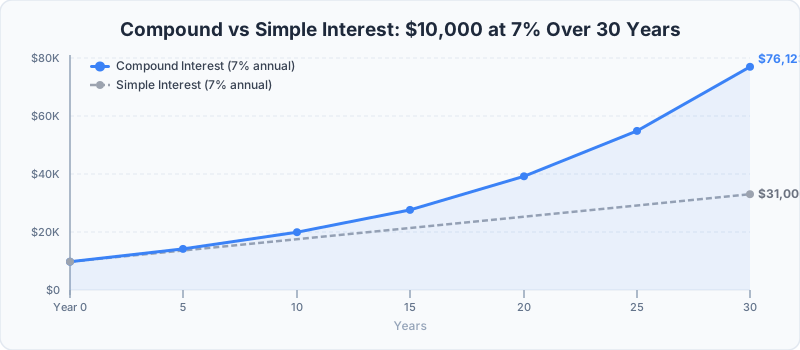
Compound interest is interest calculated on both your original principal and the interest that has already accumulated. In plain terms: you earn interest on your interest. Each time interest is added to your balance, that larger balance becomes the new base from which future interest is calculated. Over time, this creates a snowball effect where your money grows faster and faster.
To understand why this matters, contrast it with simple interest. Simple interest is calculated only on your original principal, no matter how much time passes. If you deposit $10,000 at 5% simple interest, you earn exactly $500 every year, for a total of $5,000 over ten years. Your ending balance is $15,000.
Now imagine that same $10,000 at 5% compound interest, compounded annually. In year one you earn $500, bringing your balance to $10,500. In year two, you earn 5% of $10,500, which is $525. Year three: 5% of $11,025 = $551.25. The increments keep growing. After ten years you have $16,288.95 instead of $15,000. That $1,288 difference came from nothing but the compounding effect.
Extend the timeline to thirty years and the gap becomes dramatic. Simple interest gives you $25,000. Compound interest at the same rate gives you $43,219. Albert Einstein reportedly called compound interest "the eighth wonder of the world." Whether he actually said that is disputed, but the math is not. The longer your money compounds, the more powerful the effect becomes.
There is an important flip side: compound interest works exactly the same way on debt. When you carry a balance on a credit card at 20% interest, you are on the wrong side of the compounding equation. The bank earns compound interest on what you owe, and your balance grows in the same exponential fashion unless you pay it down.
The Compound Interest Formula
The standard compound interest formula is:
A = P(1 + r/n)nt
Each variable has a specific meaning:
- A is the final amount (principal plus all accumulated interest).
- P is the principal, meaning your starting amount.
- r is the annual interest rate expressed as a decimal. A 5% rate is 0.05.
- n is the number of times interest compounds per year. Monthly compounding means n = 12. Daily compounding means n = 365.
- t is the time in years.
A Worked Example
You invest $10,000 at a 6% annual interest rate, compounded monthly, for 20 years. Plugging into the formula:
- P = 10,000
- r = 0.06
- n = 12 (monthly)
- t = 20
A = 10,000 × (1 + 0.06/12)12 × 20
A = 10,000 × (1.005)240
A = 10,000 × 3.3102
A = $33,102
Your original $10,000 more than tripled in 20 years without you adding a single dollar. The $23,102 of growth came purely from compound interest.
If you want to find just the interest earned rather than the total amount, subtract P from A: Interest = A - P = $33,102 - $10,000 = $23,102.
Simple vs Compound Interest: A Direct Comparison
The table below compares the two methods on the same $10,000 at 5% interest, checked at 5-year intervals up to 20 years. The gap widens every single period.
| Years | Simple Interest (5%) | Compound Interest (5%, annual) | Difference |
|---|---|---|---|
| 5 | $12,500 | $12,763 | $263 |
| 10 | $15,000 | $16,289 | $1,289 |
| 15 | $17,500 | $20,789 | $3,289 |
| 20 | $20,000 | $26,533 | $6,533 |
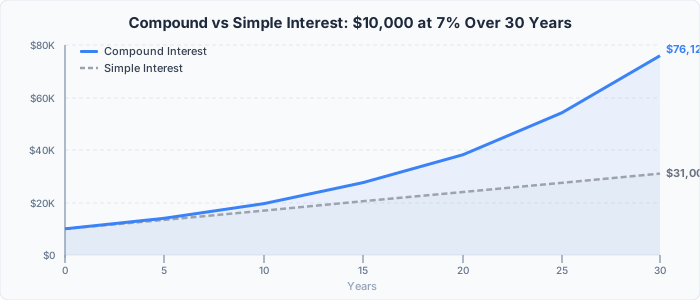
Notice that in year 5 the difference is modest: only $263. By year 20 it is $6,533. If you extended the table to 30 or 40 years, the difference becomes tens of thousands of dollars on an initial investment of just $10,000. This is the core reason why starting to save early matters so much more than saving larger amounts later.
How to Use a Compound Interest Calculator
You do not need to work through the formula by hand every time. An online compound interest calculator does all the math instantly. Here is how to use one effectively.
- Enter your starting principal. This is the amount you have right now, or the initial deposit you plan to make. If you are starting from zero, some calculators let you enter 0 and rely entirely on regular contributions.
- Enter the annual interest rate. Use the actual rate you expect to receive. For a savings account, check the current APY. For an investment portfolio, use a realistic historical average. The S&P 500 has returned roughly 7% annually after inflation over long periods, though past performance does not guarantee future results.
- Set the compounding frequency. Choose how often interest is calculated: daily, monthly, quarterly, or annually. More frequent compounding produces slightly more growth. Most savings accounts compound daily or monthly.
- Set the time period. Enter how many years you plan to let the money grow.
- Add regular contributions if applicable. Many calculators let you add a monthly or annual contribution. This makes a huge difference over time, since you are adding new principal that also compounds.
- Review the results. A good calculator shows you the total ending balance, the total interest earned, and often a year-by-year breakdown so you can see exactly how growth accelerates.
Try it now with the compound interest calculator on CalcLive. If you want to compare it to a simple interest scenario, the simple interest calculator runs that calculation so you can see exactly what compounding adds.
One practical use case: use the calculator to set a savings goal. Decide how much you want to end up with, enter a realistic rate and time horizon, and work backwards to see how much you need to start with or contribute monthly.
How Compounding Frequency Affects Growth
The formula variable n controls how often interest is added to your balance. The more frequently interest compounds, the more growth you get, because interest starts earning its own interest sooner. The difference between annual and daily compounding is smaller than most people expect, but it is real.
The table below shows what happens to $10,000 at 5% annual interest after 10 years, depending on how often it compounds.
| Compounding Frequency | Times per Year (n) | Balance After 10 Years | Interest Earned |
|---|---|---|---|
| Annually | 1 | $16,288.95 | $6,288.95 |
| Quarterly | 4 | $16,436.19 | $6,436.19 |
| Monthly | 12 | $16,470.09 | $6,470.09 |
| Daily | 365 | $16,486.65 | $6,486.65 |
Going from annual to daily compounding adds about $198 over ten years on a $10,000 investment. That is meaningful but not transformational. The interest rate and the time horizon matter far more than the compounding frequency. Do not let the promise of "daily compounding" distract you from comparing actual APYs and considering fees, both of which have a much bigger impact on your real returns.
The term APY (Annual Percentage Yield) already accounts for compounding frequency. When comparing savings accounts, use the APY rather than the nominal interest rate so you are comparing apples to apples.
Compound Interest on Debt
Everything described above about compound interest growing your savings also applies to debt. When compound interest works against you, it can turn a manageable balance into a serious financial burden surprisingly quickly.
Credit cards are the most common example. Average credit card interest rates in the United States have climbed above 20% annually in recent years. Interest on most credit cards compounds daily. If you carry a $5,000 balance and make only the minimum payment each month, you could end up paying several thousand dollars in interest and taking more than a decade to pay it off. The compounding mechanism is working powerfully against you the entire time.
Here is a concrete illustration. A $5,000 credit card balance at 22% APR, compounding daily, with a minimum payment of $100 per month: you would pay roughly $4,500 in interest before the balance is cleared, and the payoff period stretches to about five years. Doubling your payment to $200 per month cuts the interest to around $1,300 and pays it off in about two and a half years.
Student loans, personal loans, and mortgages also involve compound interest, though typically at much lower rates than credit cards. For mortgages, most of your early payments go toward interest rather than principal because of how amortization works, which is a form of compounding in practice. You can use the credit card payoff calculator to see exactly how long your current balance will take to clear and how much interest you will pay under different payment scenarios.
The key lesson: compound interest on debt is not your friend. Paying more than the minimum payment, especially early in a loan, reduces the principal faster and dramatically cuts the total interest you pay. Even an extra $50 per month on a credit card balance makes a visible difference.
Strategies to Maximize Compound Interest
If compounding is the engine of wealth growth, your job is to give that engine as much fuel, time, and space to run as possible. Here are the strategies that actually move the needle.
Start as Early as Possible
Time is the single most important variable in the compound interest formula. Someone who invests $5,000 per year from age 25 to 35 and then stops, leaving the money to compound at 7%, will end up with more at age 65 than someone who invests $5,000 per year from age 35 to 65. The early investor contributes for only 10 years. The late investor contributes for 30 years. The difference is time, and it is enormous. Start now, even if the amounts seem small.
Reinvest All Earnings
When your investments generate dividends or interest payments, reinvest them immediately rather than spending them. This keeps the entire amount working for you and accelerates the compounding effect. Most brokerage accounts and mutual funds offer automatic dividend reinvestment at no cost.
Avoid Early Withdrawals
Every dollar you withdraw resets the compounding clock for that money. Early withdrawals from tax-advantaged retirement accounts also typically trigger penalties and taxes, which means you lose twice. Unless you face a genuine financial emergency, leave invested money alone and let it grow.
Make Consistent Contributions
Regular contributions amplify compounding dramatically. Adding even $100 or $200 per month to an investment account is far more powerful than a single lump sum because each contribution starts compounding immediately from the day it is deposited. Automating contributions so they happen on payday removes the temptation to spend the money first. Use the savings calculator to model how different monthly contribution amounts affect your long-term balance.
Minimize Fees
Investment fees compound against you just as interest compounds for you. An expense ratio of 1% per year on a mutual fund sounds small, but over 30 years it can cost you hundreds of thousands of dollars in lost compounding. Prefer low-cost index funds with expense ratios below 0.2% wherever possible.
Use Tax-Advantaged Accounts
Taxes reduce compounding by shrinking the amount that earns future returns. Tax-advantaged accounts like 401(k)s and IRAs let your money compound without being eroded by annual capital gains or dividend taxes. This is covered in more detail in the next section.
Compound Interest in Retirement Accounts
Retirement accounts are the most powerful tools most people have for harnessing compound interest. They offer tax advantages that significantly accelerate long-term growth.
401(k) Plans
A 401(k) is an employer-sponsored retirement account funded with pre-tax dollars. Your contributions reduce your taxable income today, and the money grows tax-deferred, meaning you pay no taxes on the growth until you withdraw it in retirement. Many employers also offer matching contributions, which is essentially free money added to your compounding base. Contributing at least enough to capture the full employer match is one of the best financial decisions you can make. Use the 401k calculator to see how your balance could grow based on your contribution rate, employer match, and expected returns.
Traditional IRA
An Individual Retirement Account (IRA) works similarly to a 401(k) in that contributions may be tax-deductible and growth is tax-deferred. Contribution limits are lower than a 401(k), but IRAs give you more control over your investment choices since you are not limited to whatever funds your employer has selected. You can open an IRA at any brokerage and invest in index funds, ETFs, stocks, or bonds.
Roth IRA
A Roth IRA flips the tax structure. Contributions are made with after-tax dollars, so there is no deduction today. But qualified withdrawals in retirement are completely tax-free, including all the growth. For younger investors in lower tax brackets who expect to be in higher brackets later in life, the Roth structure is often the better choice. Imagine your money compounding for 30 or 40 years and then withdrawing the entire balance with no tax owed. That is the Roth advantage.
One key rule for Roth IRAs: you must be under certain income thresholds to contribute directly. High earners may need to use a strategy called a "backdoor Roth" to access the Roth structure. Consult a financial advisor or tax professional if you are close to the income limits.
The Bottom Line on Retirement Compounding
Whether you choose a 401(k), a traditional IRA, a Roth IRA, or some combination, the core principle is the same: the sooner you start contributing, the more years of compounding you access, and the larger your eventual balance. Delaying by even five years can reduce your retirement balance by 25% to 40% depending on your rate of return. Time is the one resource you cannot buy back.
Frequently Asked Questions
What's the difference between compound interest and simple interest?
Simple interest is calculated only on your original principal. Compound interest is calculated on your principal plus all previously earned interest. On a $10,000 investment at 5% for 20 years, simple interest gives you $20,000 total while compound interest (compounded annually) gives you $26,533. The difference grows larger every year, which is why compound interest is so much more powerful over long time horizons.
How often is interest compounded?
It depends on the account or loan. High-yield savings accounts and most bank accounts typically compound daily or monthly. CDs often compound daily. Credit cards usually compound daily. Mortgages and car loans are generally amortized monthly, which behaves similarly to monthly compounding. Bonds often pay simple interest semi-annually. Always check the terms of your specific account or loan to know the compounding schedule.
Is compound interest good or bad?
Compound interest is good when it works for you (savings and investments) and bad when it works against you (debt). Whether it is beneficial or harmful depends entirely on which side of the transaction you are on. For savers and investors, it is the most powerful force in personal finance. For borrowers who carry balances, especially at high rates like credit cards, it is one of the biggest financial obstacles to overcome.
What is the Rule of 72?
The Rule of 72 is a quick mental shortcut for estimating how long it takes for money to double at a given interest rate. Divide 72 by your annual interest rate, and the result is the approximate number of years to double. At 6% interest, your money doubles in about 12 years (72 / 6 = 12). At 8%, it doubles in about 9 years. At 4%, it takes 18 years. The rule works best for rates between 2% and 20% and gives results within about 1% of the precise mathematical answer. It is also useful in reverse: if you want your money to double in 10 years, you need roughly a 7.2% return.
What types of accounts are best for compound interest?
For short-term savings, high-yield savings accounts and money market accounts offer compound interest with low risk and full liquidity. Certificates of deposit (CDs) often offer higher rates in exchange for locking up your money for a fixed term. For long-term growth, tax-advantaged investment accounts (401k, IRA, Roth IRA) invested in diversified stock index funds typically produce the highest compound growth over decades, though with more short-term volatility. The "best" account depends on your time horizon, tax situation, and risk tolerance.
Does compound interest hurt you on a loan?
Yes. On most consumer loans and credit cards, compound interest increases the total amount you repay beyond what you originally borrowed. The higher the interest rate and the longer the repayment period, the more you pay. On a 30-year mortgage at 7%, for example, you might pay close to double the original loan amount in total. This is not inherently bad since it reflects the cost of borrowing money over a long period, but it is important to understand so you can make informed decisions about how aggressively to pay down debt.
How do I calculate compound interest monthly?
To calculate compound interest compounded monthly, use the formula A = P(1 + r/12)12t, where r is your annual interest rate as a decimal and t is time in years. For example, $5,000 at 6% annual interest compounded monthly for 3 years: A = 5,000 × (1 + 0.06/12)36 = 5,000 × (1.005)36 = 5,000 × 1.1967 = $5,983.40. The interest earned is $983.40. You can verify this and run your own scenarios instantly with the compound interest calculator.
Ready to Run the Numbers?
Use our free calculators to put these ideas into practice. No signup, no downloads.